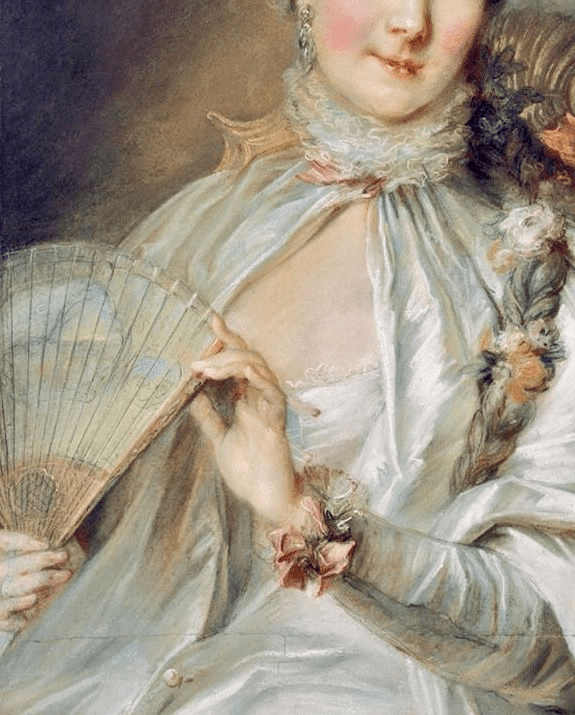
Hand fans have been around for thousands of years, originating in Egypt, India, and China, and later making their way over to Europe. During the Crusades around the year 1200, the hand fan was brought west to Europe and then was reintroduced once again through Portuguese trade with the East. Italy, France, and Spain adopted the hand fan quickly, likely due to their more southern climates. By the 18th century in Europe they were known as a ladies fashion accessory- not a necessity. Previously they had been a unisex accessory. France became the European center for fan design and production, and still today we associate hand fans with the images of the French courts. In America, fans reached the height of their popularity during the Victorian Era of the 19th century.
There were fans for all types of occasions, like weddings, funerals, dances, and other events.
Fan materials indicated wealth and status. For wealthy people, they could be made of silk, parchment, and vellum (animal skin) and could be mounted on handles of mother-of-pearl, wood, or ivory, decorated with jewels, mirrors, or enameling. French fans had handmade lace and less expensive ones were made of paper with perforations to imitate lace. For feathered fans, ostrich feathers were common in the Victorian Era, as were peacock feathers.
“Fan language” was developed between 1711 and 1740 in Europe, becoming a feature of dances and other high society events. When you look up “fan language” today, everyone seems to have different versions of what certain moves meant. Almost 300 years later, it’s hard to tell who is most historically accurate.
The language of fans, found in Godey’s 1870’s fashion book is as follows:
Carrying in right hand in front of face: Follow me
Placing it on the left ear: You have changed
Carrying in the left hand: Desirous of acquaintance
Twirling in left hand: I wish to get rid of you
Drawing across forehead: You are watched
Carrying in the right hand: You are too willing
Drawing through hand: I hate you
Twirling in right hand: I love another
Drawing across cheek: love you
Closing it: I wish to speak to you
Drawing across eye: I am sorry
Letting it rest on the right cheek: Yes
There are two main types of hand fans: folding fans and rigid fans. The so-called “golden era” of the folding fan in Europe was during the 18th century. Folding fans have 3 main subcategories of cockade, brisé, and pleated.
Cockade fan: a fan that opens up 360 degrees into a circle
Brisé fan: a fan made from a single material. Historically made of decorative wooden sticks. Today, more likely to be made of plastic.
Pleated fan: the classic type of hand fan envisioned. Sticks at the base with fabric or some other kind of material at the top.
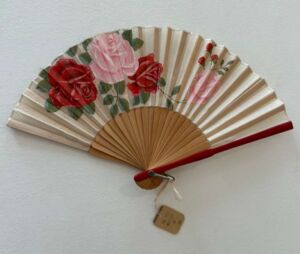
A pleated fan from our collection at the Wicoff Museum.
Rigid fans are ones that do not fold up or change shape, such as ones made of dried palm fronds.
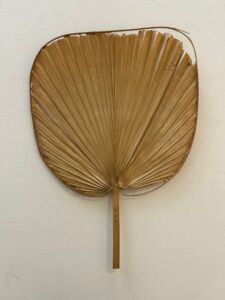
An example of a rigid fan from our Wicoff Family collection. This fan is made of a dried frond and is very fragile.
In our collection, we have both folding fans and rigid fans. Some are souvenirs from travel, some are made of dried fronds, others have been imported from “occupied Japan”, and some are commemorative ones from Princeton University. You can see the wide range of ways that hand fans could be used or decorated, which make them a popular item to collect.
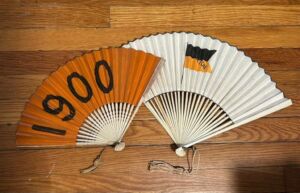
Princeton University hand fans from our collection.