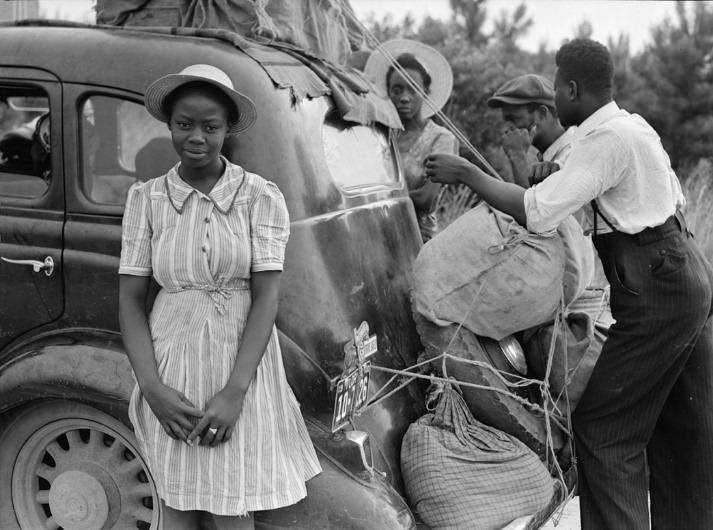
Cover photo: Jack Delano, Group of Florida migrants on their way to Cranberry, New Jersey, to pick potatoes. Near Shawboro, North Carolina, 1940. Courtesy of Library of Congress Prints and Photographs Division, Washington, DC.
As a rural town in Plainsboro’s young life, many residents made their living by farming. Dozens of families had farms, such as the Groendykes, Magnanis, Nostrands, Pettys, Parkers, and Ruedemanns, just to name a few. Though the farms employed many of the area’s residents, sometimes they needed more hands, which came from migrant workers.
Plainsboro had many migrant workers come through its farms; first, people looking for work during the Great Depression in the 30’s, then African Americans from the South in the 40s-60s. According to coastalreview.org, “Hiring migrant workers was one of the ways that farmers replaced the enslaved laborers that had harvested local crops before the Civil War”. On Plainsboro’s Magnani Farm, formerly on Scotts Corner Road, they first employed migrant workers in 1934 from Florida who had followed the harvesting of crops up the eastern seaboard. In the wintertime, the workers would be in Florida citrus groves and vegetable fields. They would often stop to pick potatoes in North Carolina in June and July, then Onley, Virginia, and then Cranbury, New Jersey. On the Magnani farm, they picked potatoes.
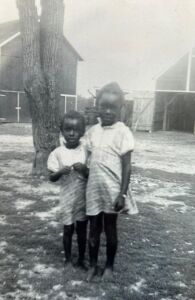
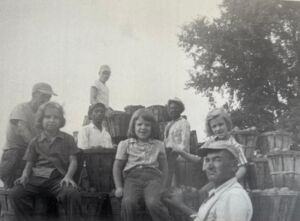
Photos: (Left) children of migrant workers on the Magnani farm, circa early 1940’s. (Right) migrant workers with Joseph Magnani (bottom right corner) and family. Photos from Magnani Family collection at the Wicoff House Museum.
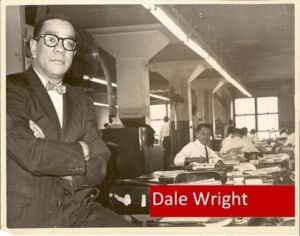 Employment as a migrant worker was a tough job, and they would often work 14-hour days, suffering wage theft, and living in horrible conditions in migrant camps. African-American journalist Dale Wright exposed these conditions in a 1961 series published in the New York World Telegram newspaper, in which he traveled from Florida to New York with the workers. According to Wright’s obituary from 2010, his 10-article series on the plight of migrant workers from Long Island to Florida won the Newspaper Guild’s Heywood Hale Broun award and was nominated for a Pulitzer Prize in 1962.
Migrant worker families would not always return south after their stay in New Jersey. Some decided to settle down in the area. The Titus family, one of Plainsboro’s most well-established Black families, came from Thomas Titus, a formerly enslaved man. Thomas’s great-grandson, Richard Titus (1897-1954), married Susie Thompson (1907-1973), the daughter of migrant workers originally from Baltimore, Maryland and Culpepper, Virginia. In 1957 Susie became one of the first female ordained African Methodist Episcopal (AME) ministers, serving in AME churches and revitalizing communities in Little Rocky Hill, Metuchen, Skillman, and Princeton. Her special focus was on helping the migrant populations in the Cranbury-Plainsboro area, knowing firsthand the living conditions of migrant camps from when she was a kid. In a Sunday Times Advertiser newspaper article from December 22nd, 1968, Rev. Titus said, “Taking kids out of the muck and the mire and seeing them rise in the world has been one of the greatest pleasures of my life”.
New Jersey, also known as The Garden State, has been farming for centuries, but if not for the workers who came from all over the country and abroad looking for ways to provide for their families in difficult economical and socio-political times, many of our farms would likely not have survived and thrived the way they did.
Sources:
https://lawrencemigration.phillipscollection.org/culture/introduction
https://coastalreview.org/2023/08/the-migrants-in-potato-fields-during-the-great-depression/
https://theworld.org/stories/2016/05/31/lesson-history-about-protecting-migrant-workers
https://princetonhistory.org/garden-tour/11.html