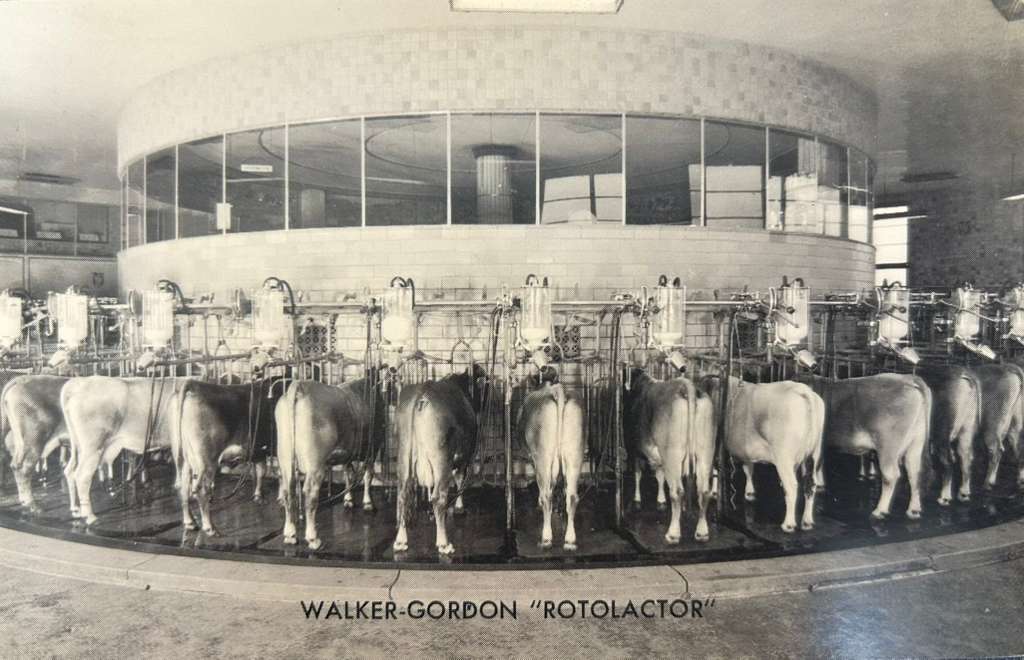
Plainsboro NJ, the home to Walker-Gordon Farms, was also the birthplace of the Rotolactor, an invention by Henry W. Jeffers that changed the dairy industry from the 1930’s onward. Rather than hand-milking cows one at a time, cows could now be mechanically milked 50 at a time- 300 an hour!
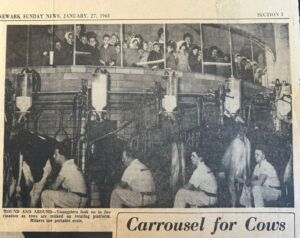
The Rotolactor was not only efficient time-wise, reducing the number of man-hours spent milking, but also revolutionary in hygiene. The machinery used for milking was sterilized after each milking and the milk was able to move from cow to bottle through a closed system, coming in to contact with only sterilized surfaces and no outside air. It is said that H. W. Jeffers was inspired by reading about Henry Ford’s assembly belt for the Model T on his trip home from Europe to study agriculture and milk production. The idea was to keep the workers stationary and bring the work (i.e. the cows) to them. The Rotolactor was so impressive that it was one of the most popular exhibits at the New York World’s Fair in 1939. Thousands of visitors also flocked to Plainsboro to see the Rotolactor in action at Walker-Gordon Farms and it was a hot spot for many school trips, as you can see in the newspaper photo below from 1963.
How did this “merry-go-round for cows” work exactly?
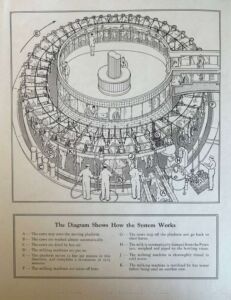 First, the cows were herded one by one onto the circular moving platform. They were then rotated to the second station where they were washed with sprinklers and hoses and dried with hot air. The milking machines were put on next and they are milked for the 12 ½ minutes while completing their rotation. The machines are then removed and the cows step off of the platform to go back to their barns. The milk is funneled away to the bottling room and the milking machines are rinsed in cold water and then sterilized in hot water before being placed on the next cow. In the diagram image you can see the observation deck in the center where visitors could watch the procession.
Here at the museum, we do not have a rotolactor, but we do have many Walker-Gordon artifacts including milk bottles, Elsie the Cow memorabilia, milker’s uniforms, and more to commemorate Plainsboro’s largest employer.