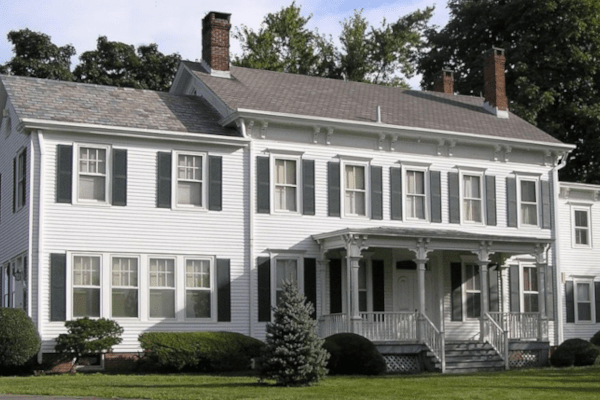
As we approach 200 years of the invention of photography, let’s take a look at the history of the photograph in New Jersey.
From research done by local photography historian Gary Saretzky, by the year 1900, approximately 3,000 people had worked in New Jersey as professional or serious amateur photographers. Newark, NJ was a hotspot for photography because it was cheaper than the going rate for photography in New York City, but with the same level of quality. These Newark photographers were the highest earning photographers in the state. As for Middlesex County, New Brunswick was the headquarters for photographers. One of the first photography organizations in New Jersey was the “Camerads”, established in New Brunswick in 1886. Among the 28 participants, 6 were women.
Some of the most popular photographers from New Brunswick in the early days of photography (and many of which are studios we have photos from in our collections here at the museum):
- J.C. Scott’s Photographic Room [1872-1892]
226 Burnet St
No. 2 Peace Street
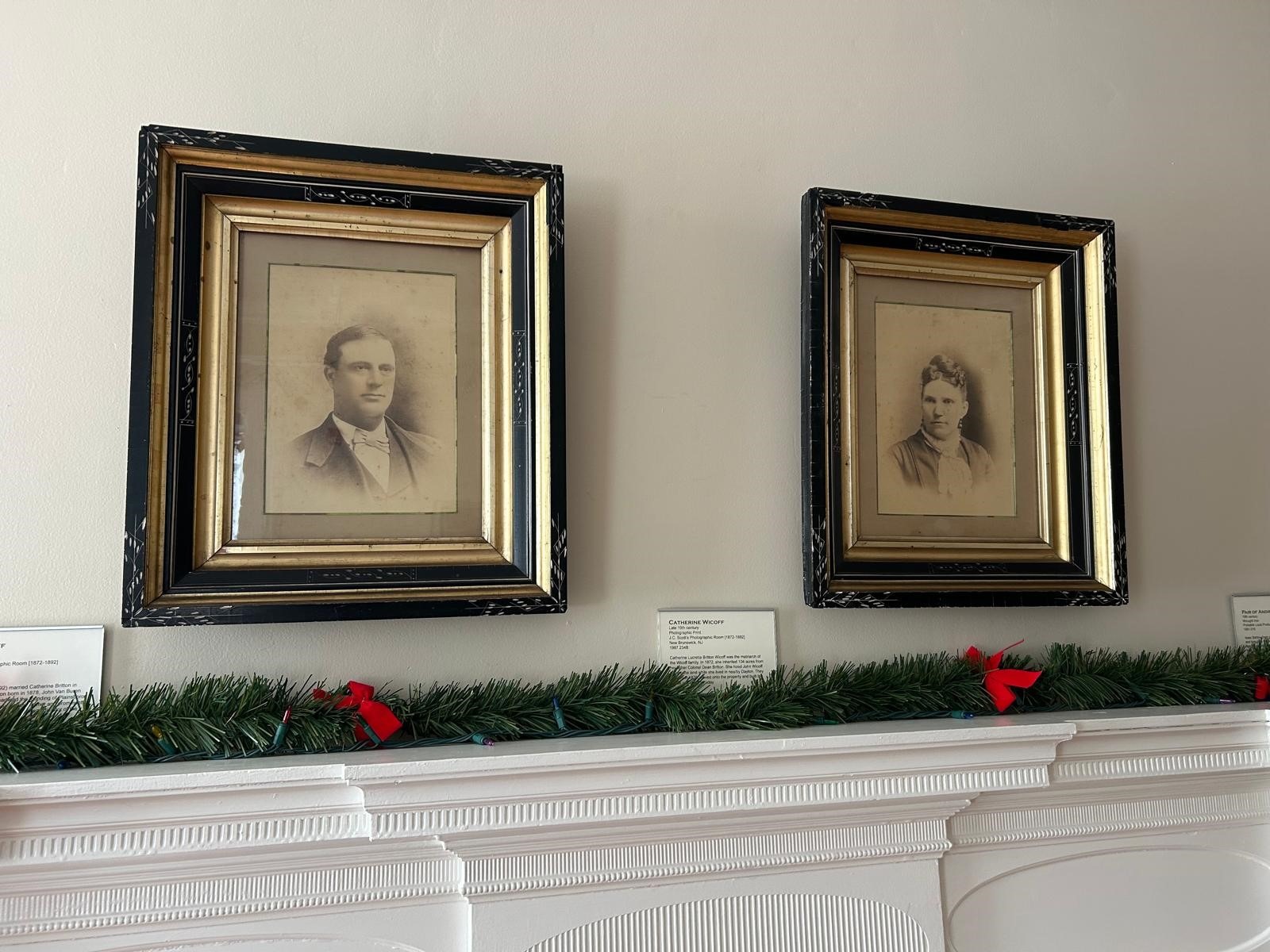
John Charles Scott (1834-1903). Began in New York, opened first gallery in New Brunswick in 1868. Succeeded Robert Boggs at Burnet St location. Moved to Peace St in 1872. Active in NB until 1890. The two large portraits of John and Catharine Wicoff that hang above the mantle in the Wicoff House Museum were taken at J.C. Scott’s studio in New Brunswick.
- David Clark, Photographer
4 King Block
(1825-1902) In 1867, Clark was the 12th highest earning photographer in the state with a gross yearly income of $1,600. Born in Connecticut in 1825. David Clark was Jonathan Vail’s successor, taking over the Peace St location. About 1863, moved to King Block. 1891 moved to George St. Exhibited daguerreotypes at the 1851 World’s Fair in London, won best in state in 1857 at the NJ State Fair.
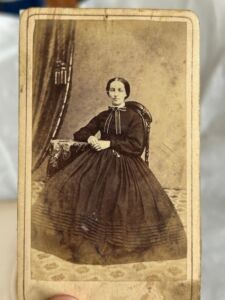
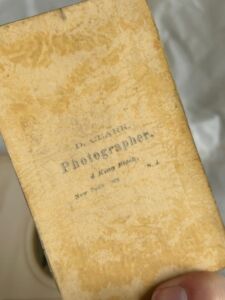
Unknown woman photographed at D. Clark’s studio in New Brunswick
- Frank P. Dunn, Artistic Photographer
No. 11 Peace Street
240 Burnett Street
Active in the 1880s-1890s. Known for the first “aerial shots” of NB from the top of the Reformed Church in 1884.
- Hawley’s Photographic Gallery
226 Burnet Street
Other contemporary New Brunswick photographers:
Robert M. Boggs – Native to New Brunswick. Studio in NB from 1860-1868, often photographing Civil War soldiers.
Jonathan H. Vail – daguerreotypist. Active 1848 to 1852 when he died. Succeeded by D. Clark.
Isaac S. Van Derveer (1880-1975) – Took over for David Clark.
Over the centuries, many different types of photography have been developed, such as daguerreotypes, ambrotypes, cyanotypes, tintypes, etc.
Daguerreotypes are the oldest type of photograph, easily recognizable by its mirror-like surface. The daguerreotype was developed in the 1830s in France by Louis Daguerre and Joseph Nicéphore Niépce and stayed in vogue until the mid-1850s when cheaper types of photography were developed.
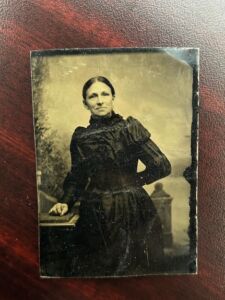 At the museum, we do not have any daguerreotypes, but we do have examples of their later successor, the tintype. For a tintype, the image is produced on a thin sheet of metal. It was introduced in Paris in 1853 and was most popular during the 1860s and 1870s, especially in North America. Tintypes were often used to capture images of the Civil War and the “Wild West”. Because the process of taking and developing the photo took only a few minutes and did not need drying, it was also used in traveling fairs and carnivals for folks to get their pictures taken.
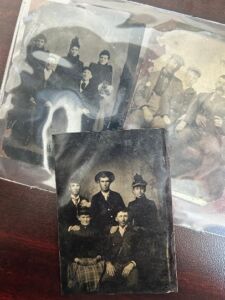
Tintype photographs of unknown people from our museum collections
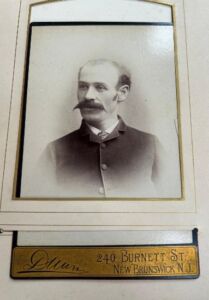 Photography did not end with the tintype and continued to take on new forms, namely, onto paper. This era is where we begin to see the two most popular types of photographs: the Cabinet photograph and the Carte de Visite (in English- the Visiting Card). CdVs can be considered the “social media” of the 1860s, as multiples could be produced cheaply and traded around to friends and visitors. They were albumen prints on thick cardstock paper, which was a big difference from the metal prints of daguerreotypes and tintypes. CdVs are typically 2.125’’ x 3.5’’ in size, approximately the size of a business card, mounted on cardstock that is 2.5’’ x 4’’. Logos of photography studios are often printed somewhere on the cardstock.
Towards the latter half of the 1860s came the larger cabinet card, named after cabinet paintings. They used the same process as CdVs but produced large photos. This is when many people started to create photo albums for cabinet cards. As you can see in the example photo to the left, this is a cabinet card being kept in an album (but slightly slid out to show the Dunn, New Brunswick studio signature).
As an archivist who works with many unlabeled photos of unknown people from unknown events during unknown times, my one massive recommendation to all is to label every photo you have- even if it’s just of yourself! You never know who might be looking at it one day.
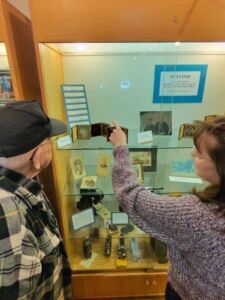
More information about antique photography in New Jersey and worldwide can be found at the Fleetwood Museum in North Plainfield, NJ.
Information, lectures, and exhibits by Gary Saretzky can also be found online at www.saretzky.com
Photo caption: Rich of the Fleetwood explaining the timeline of photography to the Wicoff Museum’s Mary Mehalick (Photo credits to Zack Zimmermann)